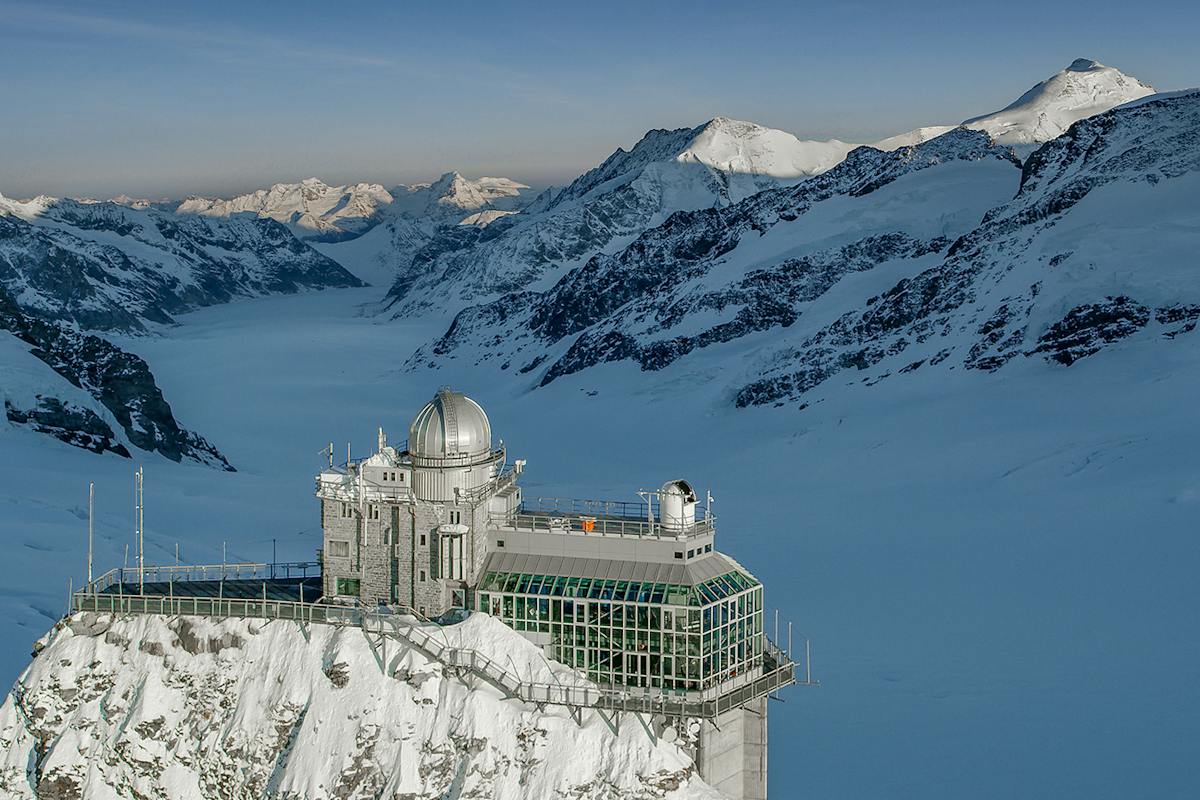
Eiger Express: the gondola that cut 47 minutes off the climb
The Eiger Express is the tricable gondola from Grindelwald Terminal to Eigergletscher. Jungfraubahnen puts the saving at 47 minutes against the classic route through Grindelwald village and Kleine Scheidegg. In practice that is the difference between a day that starts before dawn and a day that starts at a reasonable hour, which is why the Grindelwald side has become the default way up.
It is not a separate attraction with its own turnstile. The gondola is one leg of a through ticket to the top: you ride it to Eigergletscher at the foot of the Eiger, change platform, and take the Jungfrau Railway through the mountain to Jungfraujoch at 3,454 metres. What follows is what the ride involves, what it costs, when it does not run, and when the older cogwheel route is still the better choice.
The ride in numbers
The system is a 3S tricable gondola: two carrying cables plus one haul rope, which is what lets cabins of this size keep running in wind that would stop a smaller lift. There are 44 cabins with 26 seats each, the line spans 6,483 metres, and it moves up to 2,200 people an hour. Everyone sits. The glass runs floor to ceiling, so the Eiger north face fills the window for most of the climb rather than appearing in glimpses between tunnels.
On journey time, treat the round number with a little care. Jungfraubahnen gives about 15 minutes for Grindelwald Terminal to Eigergletscher. Its own brochure says 20 minutes and the printed timetable implies 18. Plan for the longer figure and you will never be caught short. The figure that matters for the day as a whole is the full one: Grindelwald Terminal to Jungfraujoch takes 45 minutes, gondola plus train plus the change at Eigergletscher.
That speed changes how long the whole outing takes. Jungfraubahnen's own guidance is at least three and a half to four and a half hours for the round trip via the Eiger Express, against five to six hours via Wengen and the Wengernalp line. If you have one day in the region and want a mountain and a valley walk in it, this is where the time comes from.
Eiger Express or the classic cogwheel route?
The honest answer is that the gondola wins on time and the train wins on scenery, and most visitors should use both. The classic route runs Lauterbrunnen to Wengen to Kleine Scheidegg, and from Kleine Scheidegg the Jungfrau Railway takes 44 minutes to the top, including the stop at Eismeer. That stop is worth knowing about: the train pauses at a gallery window cut into the rock at 3,160 metres for about five minutes, and it is on the Kleine Scheidegg side of the tunnel only. It is not guaranteed on every service, and it does not happen at all if you join at Eigergletscher.
So the standard plan is up one way and down the other. Go up early via the Eiger Express, when speed is worth the most and the light on the north face is still hard, then come down by train through Kleine Scheidegg and Wengen, when you have the afternoon to spend and the valley opens out below the track. A through ticket from Grindelwald Terminal or Interlaken Ost covers both sides of that loop, so you are not buying two tickets to do it.
Take the gondola both ways if you are short of time, travelling with small children, using a wheelchair or a pushchair, or arriving on a day when the cloud base is low and you simply want to get above it. Take the train at least one way if the weather is good, you want the Eismeer window, or you are the sort of traveller who would rather sit at a mountain station for half an hour than save the half hour.
Grindelwald Terminal: parking, boarding and step-free access
The Eiger Express starts at Grindelwald Terminal, which is a purpose-built interchange on the valley floor below Grindelwald village, not in the village centre. That distinction matters when you book: the terminal has its own station on the line from Interlaken Ost, its own multi-storey car park, and the gondola boarding hall is part of the same building, so the transfer from car or train to cabin is done indoors.
It is also the step-free way to the top. Interlaken Ost to Grindelwald Terminal, the Eiger Express itself, and the Jungfrau Railway from Eigergletscher upward are barrier-free end to end. One companion travels free with each wheelchair user. The Kleine Scheidegg route is the one that needs a phone call in advance, so if step-free access is the deciding factor, the gondola is not a preference, it is the route.
Dogs travel free on the valley legs and on the gondola. The stretch from Eigergletscher up to Jungfraujoch costs CHF 30 for a dog, and dog tickets are not sold online, so that one is settled at a counter on the day.
What a ticket including the Eiger Express costs
There is no standalone "gondola only to the top" ticket. You buy a return to Jungfraujoch from a starting station, and the routing over the Eiger Express is what makes the Grindelwald Terminal fare the lowest of the sensible options. The table below shows the lowest return fare we currently list per person from Grindelwald Terminal, in Swiss francs, as sold on Headout for the fare year that ends on 12 December 2026. Every ticket includes a reserved seat on a return departure about 3 hours after arrival.
| Departure station | Adult | Child | Book |
|---|
| Grindelwald Terminal | from CHF 211 | from CHF 30 | Check availability |
From prices per person, rounded to whole francs; the exact price depends on the travel date. Half Fare Card and Swiss Travel Pass holders choose their ticket type at checkout. The Zurich day trip includes transfers and a guide.
There is no seat reservation to add: the reserved return seat is already part of every ticket, on the gondola as well as on the Jungfrau Railway, and the outbound time slot is chosen at booking. And the Half Fare Card and Swiss Travel Pass fares are not separate products: they are ticket types inside the same ticket, picked at checkout, valid only if you hold the card or pass on the travel date. Starting from Interlaken Ost instead costs more, because that fare also covers the run down to the lake. Our Jungfraujoch ticket prices table sets out every combination side by side.
Timings, and the boarding-time trap
The time printed on your ticket is the boarding time at Grindelwald Terminal, not the departure time from wherever you are staying. If you are coming from Interlaken Ost, Wilderswil, Lauterbrunnen or Grindelwald village, leave at least 30 minutes earlier than that printed time. People miss reserved slots over this every week in summer.
Scheduled times shift with the season, so treat the following as the current block rather than a fixed rule and check jungfrau.ch operating info before you travel. In the block running 24 August to 25 October 2026, the first Eiger Express cabin goes at 07:45, the last cabin up is at 17:45 and the last one down is at 18:20. Above it, the train from Eigergletscher to Jungfraujoch first runs at 08:15, last goes up at 17:15 and last comes down at 17:47. There is no separate opening time for the summit: the mountain is open for as long as the railway is running, and the "last train up at 2 pm" you may have read on other sites is an invention.
Crowding follows a pattern worth planning around. In summer the quiet windows are the very first connection and the late afternoon. In winter it inverts, because skiers fill the early cabins, so a later start is the calmer one.
When the Eiger Express does not run
Cableways need annual maintenance, and the dates are published well ahead. The Eiger Express is out of service from 9 to 20 November 2026. Jungfraujoch itself stays reachable throughout, by the alternative route, so a November trip is not cancelled, just slower and routed over Kleine Scheidegg instead.
The neighbouring lines have their own windows, which is the reason to check both before fixing a date. Grindelwald to Kleine Scheidegg closes from 27 April to 8 May 2026 and again from 26 October to 6 November 2026. Wengen to Kleine Scheidegg closes from 9 November to 4 December 2026. From 9 to 20 November 2026 the gondola and the Wengen line are shut at the same time, which leaves a thinner set of options than the calendar suggests at first glance.
How to plan it, in four steps
- Pick your starting station before your ticket. Grindelwald Terminal is the cheapest sensible start at from CHF 211, and it has the car park. From Interlaken Ost the same day costs from CHF 234, with the valley leg included. Our Grindelwald to Jungfraujoch page covers the terminal in detail, and Interlaken to Jungfraujoch does the same for the lake end of the valley.
- Read the time slot twice. The time on the confirmation is your boarding time at the terminal, so work backwards by at least 30 minutes from wherever you sleep. The reserved return seat sits about 3 hours after your arrival at the top.
- Book early, even if the weather is unsettled. There is no bad-weather refund on a standard ticket, but every ticket cancels free up to 24 hours before travel. Check the forecast one or two days before and cancel or rebook if it looks poor; the jungfrau.ch webcams on the morning of travel are a last look only.
- Plan the descent, not just the ascent. Down by train through Kleine Scheidegg turns the return into the scenic half of the day. If you would rather have the extra hours in the valley, take the gondola back down and use them on a walk from Grindelwald instead.
What the Eiger Express does not do
It does not skip the queue at the top, it does not change the altitude, and it does not make the summit any warmer. Above 3,000 metres the thin air is the same whichever way you arrived, and arriving faster gives your body less time to adjust, not more. Altitude sickness is possible from 2,500 metres upward, and you lose roughly 200 millilitres of fluid an hour simply by breathing up there. Both of those apply more sharply when you have gone from valley floor to 3,454 metres in three quarters of an hour. Drink more than you feel like drinking, move slowly for the first quarter of an hour, and take sunglasses: Jungfraubahnen warns of a considerable risk of snow blindness on the glacier without them, in poor weather as much as in sunshine.
It also does not remove the queue on a peak summer Saturday. The official guidance is blunt that waits can exceed two hours at busy times, with no refund for the lost time. The gondola's 2,200 people an hour is a high figure for a cableway, but the railway above it and the terraces above that are the bottleneck, not the cabins.
None of which is an argument against it. For most visitors on most days the Eiger Express is the right way up: faster, step-free, sold on the same through ticket, and with a view of the north face that the tunnel route cannot offer. Take it early and come down the long way.
 Best value