Sphinx Observatory: the highest terrace at Jungfraujoch
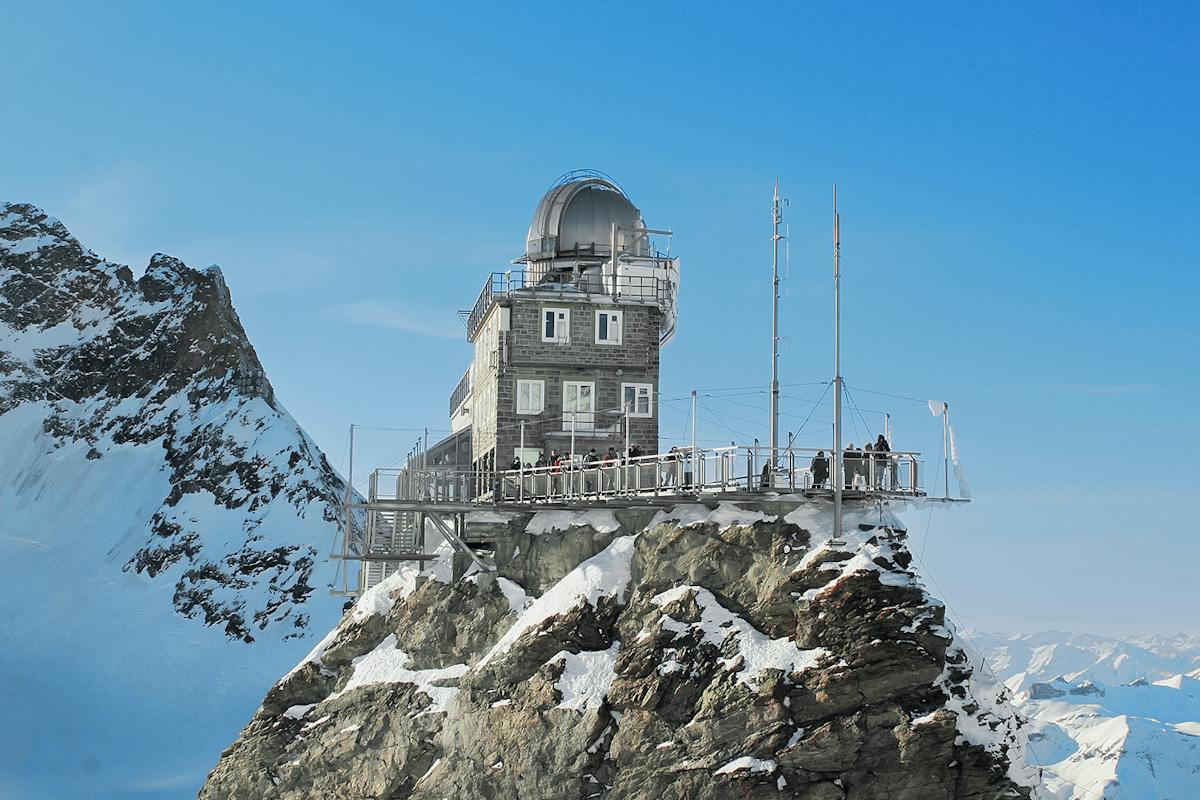
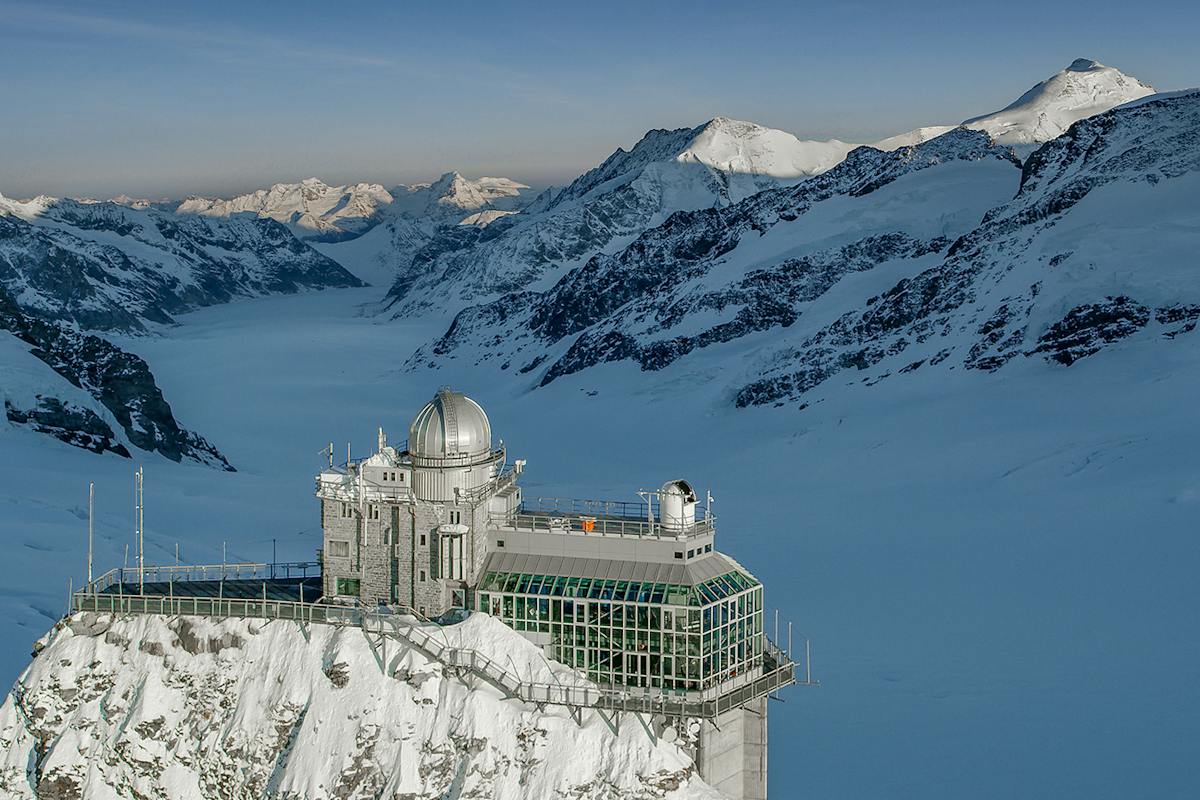
The Sphinx Observatory is the viewing terrace at 3,571 metres that sits above the Jungfraujoch station, and it is where almost every visit peaks. A lift climbs 108 metres in 25 seconds to reach it, from the tunnel level where the railway leaves you to the platform in the open air. Step out and the Aletsch Glacier is below you, running away to the south for 22 kilometres.
The terrace is part of every Jungfraujoch ticket, so there is nothing extra to buy on the day and no separate queue to pay for. It is also the part of the visit that depends most on the weather, because a viewing platform in cloud shows you cloud.
What you see: the Aletsch Glacier
The view south from the Sphinx Observatory is the Great Aletsch Glacier, the largest in the Alps. The Jungfrau Railways put its length at 22 kilometres; Switzerland Tourism says 23, which tells you how these things are measured rather than that anyone is wrong. It is about 900 metres thick at its deepest and holds roughly 12 billion tonnes of ice. The glacier and the mountains around it are a UNESCO World Heritage site.
That is the headline, but the detail is what holds people on the terrace for longer than they planned. The ice is not white and flat. It is grooved into long dark stripes where two arms of the glacier have merged and dragged their rocky edges into the middle, and it bends out of sight like a motorway seen from a plane. On a clear morning the surface reads as a series of curves; by early afternoon the light flattens and the same view looks like a plain.
Turn the other way and you are looking north over the ridge the railway tunnelled through. What you can pick out on that side depends entirely on the day. Plenty of visitors go up in high summer and see nothing but the inside of a cloud, and plenty go up in February and get several hundred kilometres of clear air.
Is the Sphinx Observatory included in the ticket?
Yes. The Sphinx Observatory is included in the standard return ticket to Jungfraujoch, along with the Plateau, the Ice Palace and the Alpine Sensation corridor. The only things at the top that cost extra are food, shopping and the Snow Fun Park, which is a separate ticket for the zipline, the sledging run and the ski and snowboard area.
What you pay is the journey itself. A full-fare adult return from Interlaken Ost starts from CHF 234. Half Fare Card holders pay from CHF 122, Swiss Travel Pass holders from CHF 157, both chosen as the ticket type at checkout on the same ticket. Every ticket includes a reserved seat on a return departure about 3 hours after arrival, which is comfortably enough for the terrace, the Ice Palace and a meal. Our Jungfraujoch ticket prices table sets out every origin and ticket type.
Weather decides what the Sphinx Observatory gives you
No other attraction at the top is as exposed to the day's conditions as the Sphinx Observatory. It is the one part of the ticket the sky can take away from you. The Ice Palace looks the same in a storm as it does in sunshine, and so does the Alpine Sensation. The terrace does not.
The useful habit is to book early and let the cancellation window do the work. Every Jungfraujoch ticket cancels free up to 24 hours before travel. There is no bad-weather refund once you travel, so the cancellation window is your only protection. Check the mountain webcams a day or two before travel, then keep the booking or move it. Our Jungfraujoch weather and webcams page explains what to look for on the cameras and what the MeteoSwiss climate figures actually mean at 3,454 metres.
One thing the cameras cannot tell you is what the cloud will do in three hours. Summit weather moves. A terrace that was closed in by mist at ten can be clear at noon, which is an argument for not rushing the indoor parts of the visit if you arrive to a grey window.
Sun, photographs and the snow blindness warning
Sunglasses are essential kit here, and this is not a comfort issue. The Jungfrau Railways medical advice puts it bluntly: "There is a considerable risk of snow blindness on the glacier if sunglasses are not worn! This also applies in bad weather, as the UV rays are still present." Take that literally on an overcast day, when nothing feels bright enough to bother.
For photographs, a few things follow from the place itself rather than from any camera advice.
- Go out before you settle in. The light and the cloud change faster than your schedule does. Shoot the glacier when you first see it, then come back later for the version with better light.
- Expect glare, not darkness. Snow and ice under a high sun push most automatic exposures too dark. If your phone gives you grey snow, raise the exposure by hand.
- Keep the battery warm. Cold drains phone batteries quickly, and the terrace is outdoors at 3,571 metres in air that is below freezing for most of the year. An inside pocket is enough.
- Use the railings, not a tripod. The terrace is a working platform with other people on it, and the wind up there does not help long exposures.
- Save time for the small things. Most people photograph the glacier first and forget the small things: boots on the metal grating, the drop below the deck, the tunnel entrance you came out of.
How long to allow, and when to go up
Allow about 15 minutes on the Sphinx Observatory itself if the weather is poor, and considerably more if it is not. The official guidance for the whole visit is at least three and a half to four and a half hours from Grindelwald Terminal via the Eiger Express, or five to six hours if you take the classic route over Wengernalp and Kleine Scheidegg. The terrace is one of five or six things competing for that time.
Crowds follow a predictable pattern. In summer the quiet slots are the first connection of the day and the late afternoon, with the middle of the day the worst of it. In winter the pattern inverts, because skiers fill the early trains and a later start is calmer. The official FAQ is honest that waiting times "can exceed 2 hours" at busy moments, and there is no refund for a wait.
A workable order on a clear day is to go straight up to the Sphinx Observatory terrace on arrival, before the next two or three trains empty out behind you, and keep the Ice Palace and the corridor exhibits for the middle of your stay. On a grey day, invert it: do the indoor parts first and give the sky a chance.
Altitude at 3,571 metres
The Jungfraujoch station stands at 3,454 metres and the terrace above it at 3,571 metres. Altitude sickness is possible from 2,500 metres, so both are in the range where some people feel it. The usual signs are headache, light nausea, breathlessness on stairs and a heart that will not settle. The lift makes it worse in one specific way: you gain the last 108 metres in 25 seconds and then walk out into cold air, which is exactly the moment people notice they are short of breath.
Move slowly, take the stairs at the top gently or not at all, and drink more than you think you need, since roughly 200 millilitres of fluid an hour is lost through breathing alone at this height. The Jungfrau Railways advise against the trip after a recent stroke or brain haemorrhage, with severe asthma or COPD, on dialysis, with a cold or a fever, from the seventh month of pregnancy, and for children under two years old. If any of that applies, a lower viewpoint is the better day out.
How to plan it, in four steps
- Buy the route ticket, not an add-on. The terrace is included, so the only decision is the route and the ticket type. The reserved return seat comes with the ticket.
- Check the webcams before you commit. Free cancellation runs to 24 hours before travel, so booking early costs you nothing: keep the free cancellation window in hand and cancel if the forecast turns.
- Go up to the terrace first if it is clear. Sunshine at 3,571 metres is not a stable commodity. The indoor attractions are not going anywhere.
- Pack sunglasses, gloves and a warm layer. The terrace is outdoors, the sun is unfiltered and the air is cold even in August.
What sits next to it
The Sphinx Observatory is one of several things included in the same ticket, and the others are all within a few minutes of it inside the complex. The Plateau is the snowfield at 3,454 metres where the flags and the marked path are, and it holds snow all year. The Ice Palace is the set of chambers cut into the glacier ice at a constant minus three degrees Celsius. The Alpine Sensation is a 250 metre corridor with 30 memorial tablets for the workers who built the tunnel, opened on 30 March 2012 for the railway's centenary.
Beyond those, the top station has Europe's highest post office, working since 1912 with its own postcode 3801, a Lindt chocolate shop, several restaurants, free WiFi under the network name visitors@JB and a free 90 minute audio Discovery Tour you can run on your phone. Most visitors do the terrace, the Plateau and the Ice Palace, eat something and go down. That is a reasonable plan, and the terrace is the part to give the extra half hour to if the sky cooperates.
 Bestseller