Ice Palace Jungfraujoch: chambers cut into the glacier
The Ice Palace Jungfraujoch is a set of corridors and chambers cut directly into the glacier ice below the top station at 3,454 metres, held at a constant minus three degrees Celsius. It is included in every ticket to the Jungfraujoch, it takes about 15 minutes to walk through, and it is the one attraction up there that looks exactly the same in a snowstorm as it does in sunshine.
The terrace and the Plateau are at the mercy of the cloud; this is not. If you arrive to a grey window, the Ice Palace and the Alpine Sensation corridor are what you do while you wait for the sky to make up its mind.
Cut by hand in the 1930s
The Ice Palace Jungfraujoch was carved out in the 1930s by mountain guides working with hand tools inside the ice of the glacier. Nothing about it is a modern engineering feat with lighting rigs and refrigeration plant. It is a tunnel system in moving ice, kept open and reshaped over the decades, and the walls still carry the marks of the tools that opened them.
Because the ice moves, the place is not fixed in the way a building is. Corridors shift, get re-cut, and are reworked. What you walk through is a maintained space inside something that is slowly flowing downhill, which is a strange idea to hold in your head while you are standing in it.
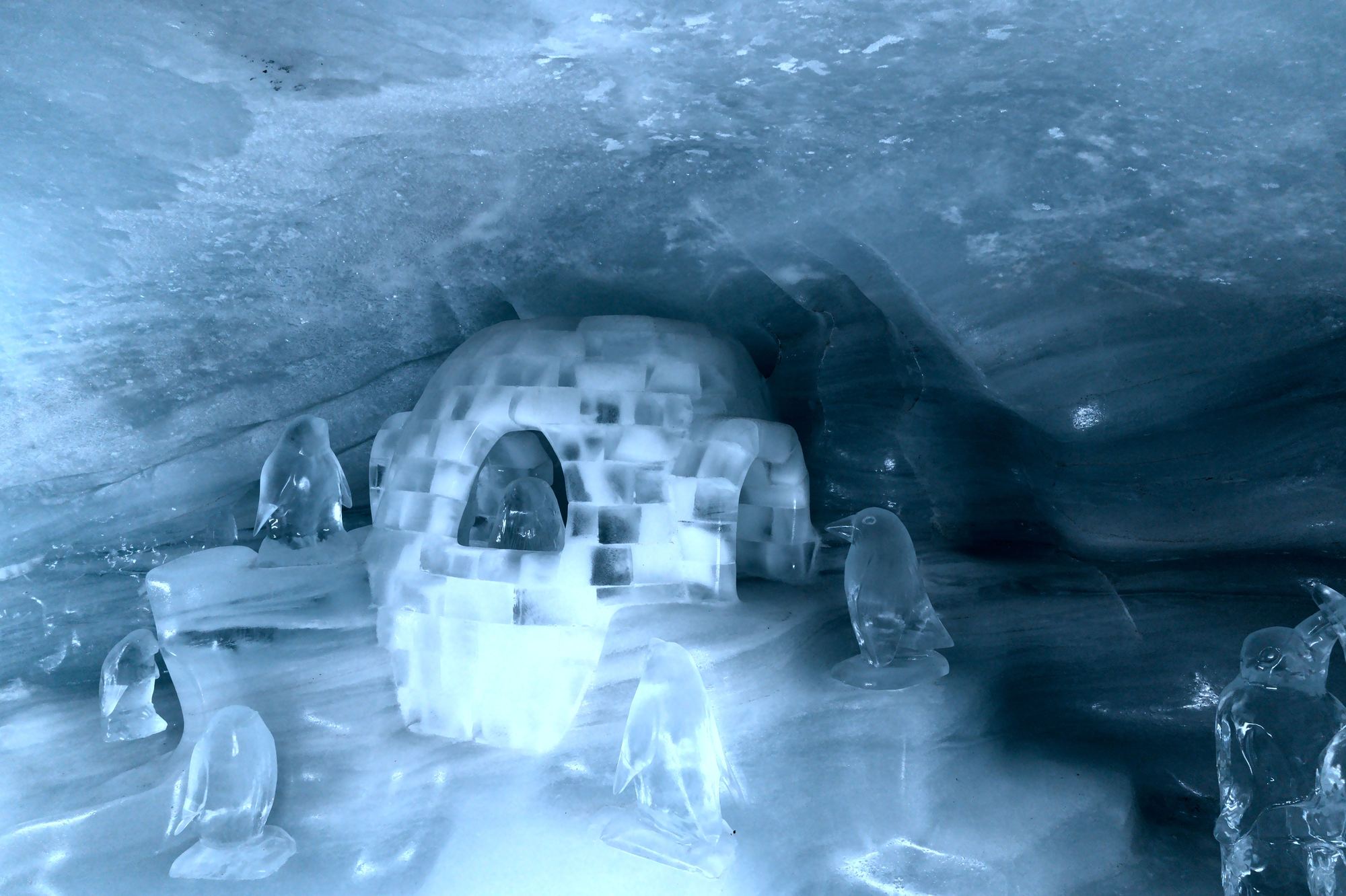
The carvings in the ice are the part most people photograph. They are lit from within the ice itself in places, which is why the blue reads so much stronger in photographs than you expect from looking at the ceiling of a tunnel.
Is the Ice Palace Jungfraujoch included in the ticket?
Yes, and there is no separate ticket desk. The Ice Palace Jungfraujoch, the Sphinx terrace at 3,571 metres, the Plateau and the Alpine Sensation are all covered by the ordinary return journey to the top. The only things that cost extra once you arrive are food, shopping and the Snow Fun Park, which sells its own tickets for the zipline, the sledging run and the ski and snowboard area.
The cost is the journey. A full-fare adult return from Interlaken Ost starts from CHF 234. Half Fare Card holders pay from CHF 122, Swiss Travel Pass holders from CHF 157, all as ticket types on the same ticket chosen at checkout. Children aged 6 to 15 pay CHF 30 flat, and every ticket includes a reserved seat on a return departure about 3 hours after arrival. Our Jungfraujoch ticket prices table lays out every origin and ticket type.
Minus three degrees, all year
The temperature inside holds at minus three degrees Celsius whatever the season. Set that against the MeteoSwiss climate normals for Jungfraujoch, measured from 1991 to 2020: the annual mean is minus 6.7 degrees, February averages minus 12.6 and August averages plus 1.3.
| When | Typical outside air | Inside the ice | What that means |
|---|
| August | About plus 1.3 degrees on the monthly mean | Minus 3 degrees | The coldest part of a summer visit. Summer visitors in shorts feel it within a minute |
| Year round | About minus 6.7 degrees on the annual mean | Minus 3 degrees | Slightly warmer than the annual average outside, so a mild change |
| February | About minus 12.6 degrees on the monthly mean | Minus 3 degrees | Warmer inside than out. The corridors are a break from the cold, not an extra dose of it |
The common mistake is assuming Jungfraujoch is frozen solid all year and dressing for February in August. It is not: the official position is that the hottest months are regularly above the zero degree limit. The ice corridors are the exception, because they are refrigerated by the glacier around them rather than by the day's weather.
Shoes matter more than coats
The floor is ice, polished smooth by everyone who has walked it that day, and it slopes in places. Handrails run along the corridors, and people use them. Shoes with a grippy sole are the difference between an easy quarter of an hour and a careful shuffle.
- Wear shoes with tread. Walking boots, trainers with a proper sole or winter boots all work. Smooth-soled town shoes and any kind of heel do not.
- Keep your hands free. Holding a phone out in front of you on ice is how people fall. Take the photograph standing still.
- Bring a warm layer for it, not for the whole day. Fifteen minutes at minus three is manageable in a fleece and a jacket. You do not need expedition clothing.
- Watch children on the slopes in the floor. They will want to slide. The corridors are narrow and other people are coming the other way.
- Take gloves. Bare hands on the ice walls and railings get cold fast, and you will be tempted to touch the walls.
Combine it with the Alpine Sensation
The Alpine Sensation is the other indoor stretch inside the complex, and the two work as a pair. It is a 250 metre corridor that opened on 30 March 2012, a hundred years after the railway first reached the Jungfraujoch, and it carries 30 memorial tablets for the workers who built the tunnel through the mountain. Allow about 15 minutes there too.
Taken together, the ice chambers and the memorial corridor cover roughly half an hour of the visit, all of it under cover, and the pairing tells the same story from two angles: the ice the tunnel runs through, and the people who cut the tunnel. Most visitors walk the Alpine Sensation without stopping because it sits on the route between the station and the rest of the complex. It repays reading the tablets.
If your day is short, this pair plus the Sphinx terrace is the core of the visit. Everything else, the Plateau, the shops, the post office, the restaurants, is optional in a way these are not.
How long to allow, and when to go in
Fifteen minutes is the working figure for the ice corridors. The full visit to the top is officially at least three and a half to four and a half hours from Grindelwald Terminal by the Eiger Express, or five to six hours by the classic route over Kleine Scheidegg. That time has to cover the terrace, the Plateau, the two indoor stretches, and something to eat.
The timing rule is simple: do the outdoor parts when the weather is good and save the ice for when it is not. On a clear morning, go up to the Sphinx first and come back down to the corridors later. On a day of low cloud, walk the ice and the memorial corridor first and give the sky two hours to clear. Our Jungfraujoch opening hours and timetable page explains the seasonal service blocks, and there is no separate opening time for the attractions inside: the mountain is open while the railway runs.
The Ice Palace Jungfraujoch is easy to lose half an hour in, and the descent is not something to leave to chance. Note your last connection when you arrive, not when you start to feel tired.
How to plan it, in four steps
- Buy the journey, nothing else. Entry to the ice corridors is included in the return ticket, and so is the reserved return seat. Book the route that suits your base and pick a time slot that gives you a calm morning.
- Pack shoes with grip. This is the one piece of kit specific to the ice. Everything else you need at the top is the standard warm layer, gloves and sunglasses.
- Slot it against the weather. Clear sky on arrival means terrace first, ice later. Cloud on arrival means ice first, terrace later.
- Pair it with the Alpine Sensation. The 250 metre memorial corridor with its 30 tablets is a few minutes away and takes about the same time again.
What else the same ticket covers
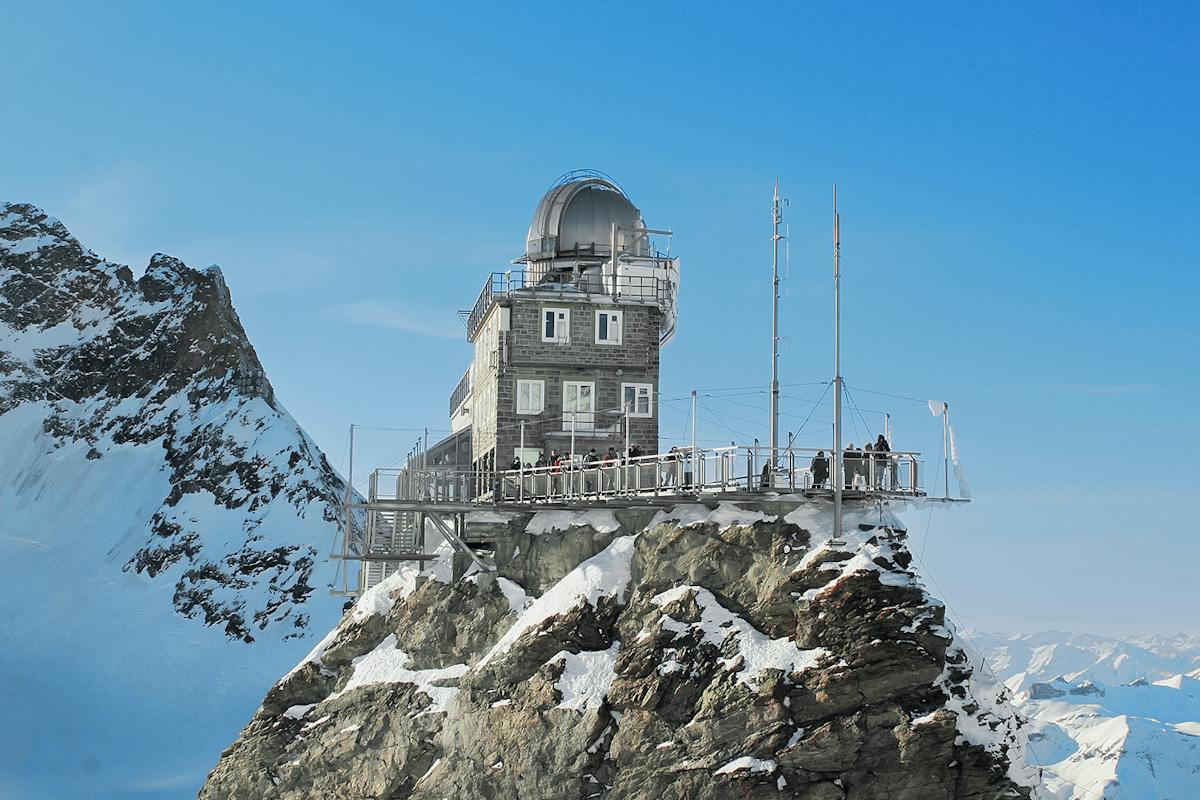
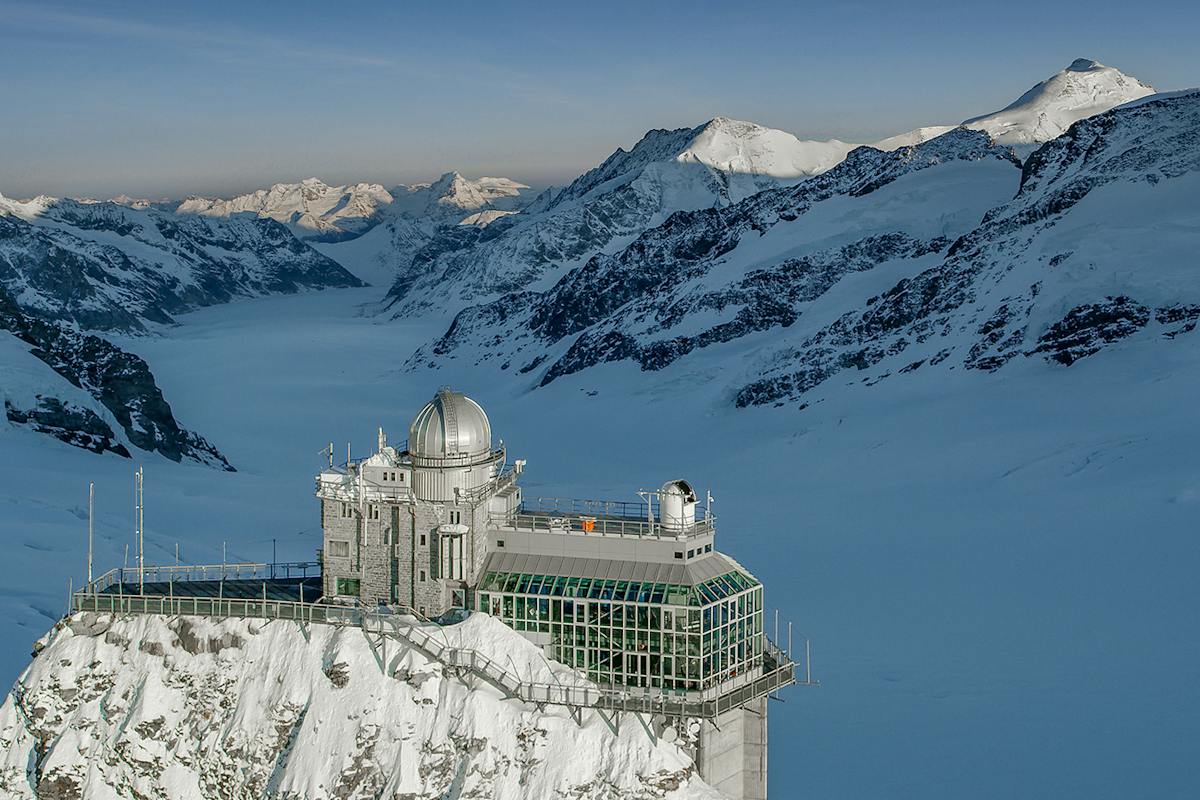
The ice corridors are one of four things the standard fare includes at the top. The Sphinx Observatory terrace at 3,571 metres is reached by a lift that climbs 108 metres in 25 seconds and looks out over the Aletsch Glacier, 22 kilometres of ice up to 900 metres thick and part of a UNESCO World Heritage site. The Plateau is the snowfield outside at 3,454 metres, with snow all year. The Alpine Sensation is the corridor described above.
Around those, the complex has Europe's highest post office, open since 1912 with its own postcode 3801, a Lindt chocolate shop, restaurants including one that serves a la carte from 11:00 to 14:30 every day of the year, free WiFi on the network visitors@JB, and a free 90 minute audio Discovery Tour that runs on your own phone. None of that changes the shape of the visit. The ice, the memorial corridor and the terrace do.
 Bestseller