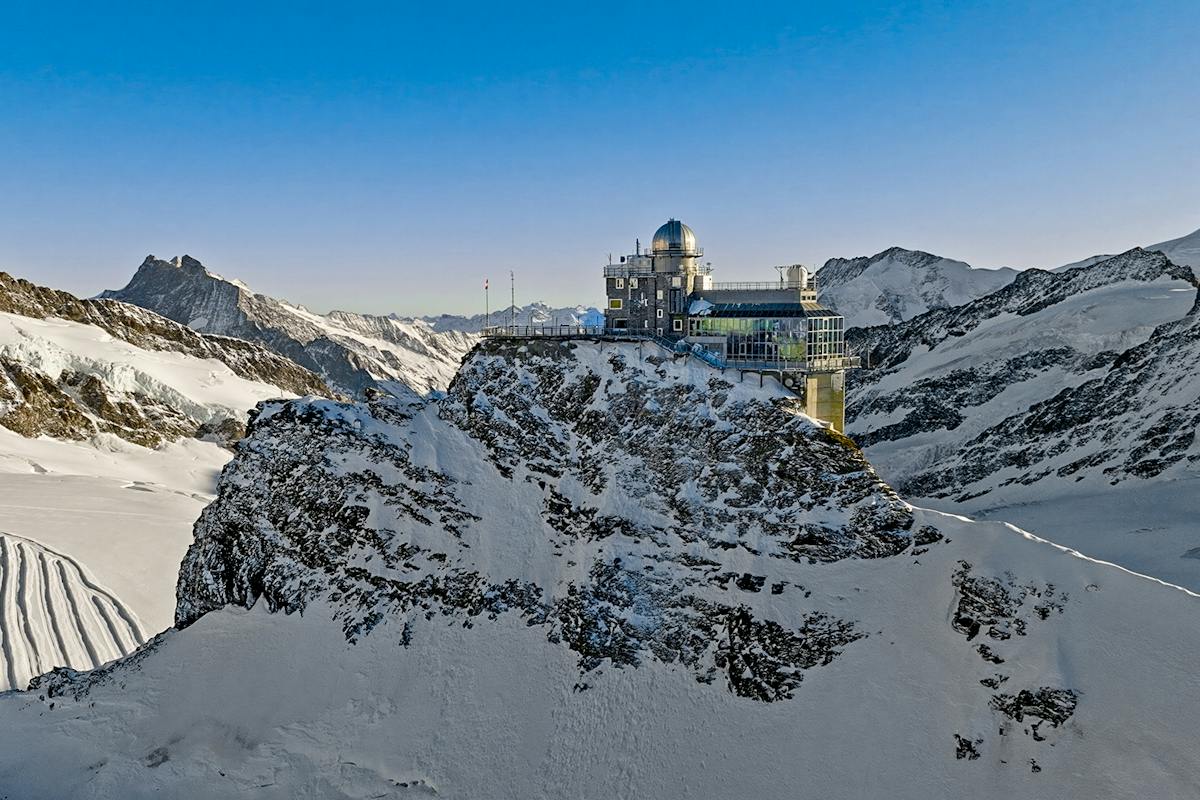
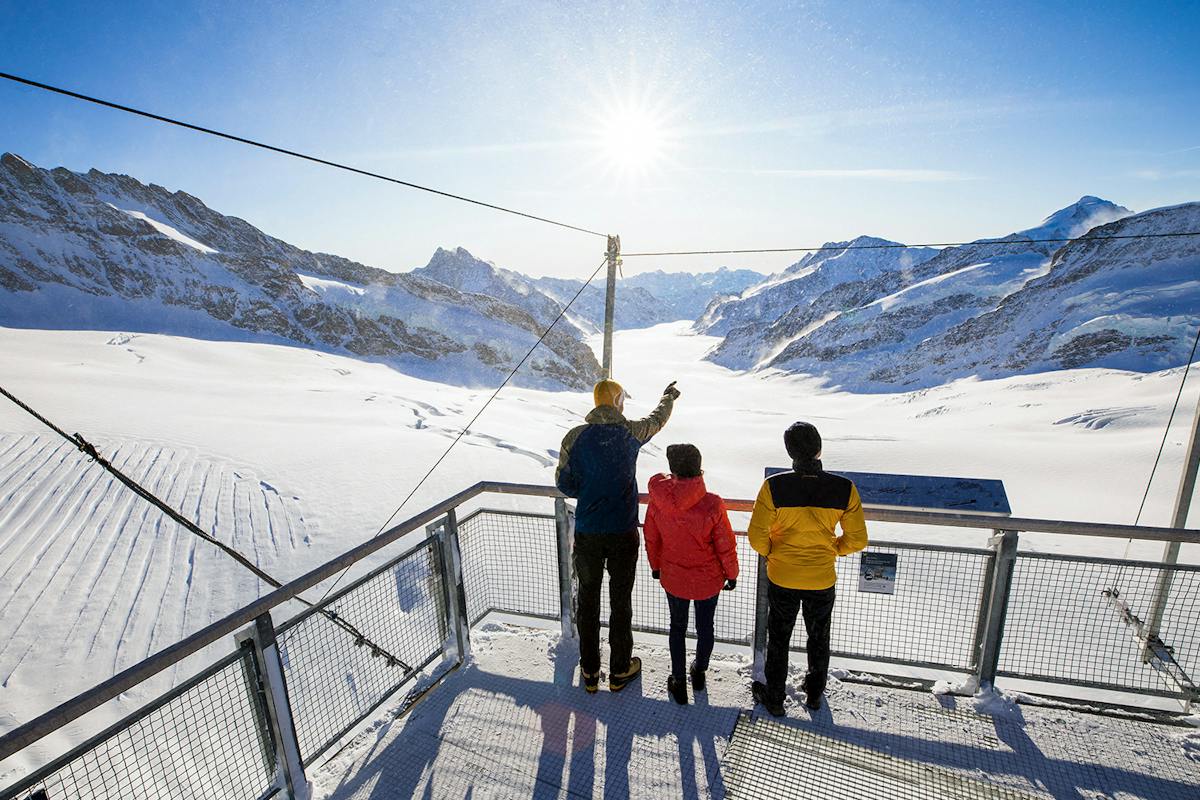
Zurich to Jungfraujoch in a day: what it really takes
Zurich to Jungfraujoch is a long day out, but it is a real one: roughly two hours by train from Zurich HB to Interlaken Ost, then about another two hours up the mountain, with the same again coming back. Twelve hours door to door is the honest figure, which is exactly the duration the organised coach and rail tours quote for the same trip.
The decision is not really whether to go. It is whether to arrange it yourself with rail tickets or to buy a guided day trip that includes the transfers. Pricing only the mountain ticket and forgetting the journey to the valley gives an incomplete picture. Below is the arithmetic, along with the timings that make or break the day.
The timings that decide the whole thing
Everything hangs on the last connection down, not the first one up. In the timetable block running 24 August to 25 October 2026, the first connection out of Interlaken Ost leaves at 07:04 and reaches the summit at 08:41. The last return gets back to Interlaken Ost at 19:24 off a 17:45 departure from the mountain. Blocks change several times a year, so treat those as scheduled service and check jungfrau.ch operating info for your own date before committing to anything.
Work backwards from that and the shape of a Zurich to Jungfraujoch day becomes obvious. To catch the 07:04 from Interlaken Ost you are leaving Zurich around five in the morning. Take a later train and you compress your time at the top, because the descent still has to start by late afternoon. There is no way to stretch the day at the other end: the mountain has no opening hours of its own, it is open for as long as the railway runs, and when the last train goes, it goes.
The time printed on a Jungfraujoch ticket is the boarding time at Grindelwald Terminal or Kleine Scheidegg, not your departure from Interlaken Ost, and certainly not from Zurich. It catches people out every summer, so leave Interlaken Ost at least 30 minutes before the time on your confirmation.
Doing it yourself by train
The independent version of Zurich to Jungfraujoch is straightforward and needs no guide. Zurich HB to Interlaken Ost takes about two hours. From Interlaken Ost you have a choice of two routes to the top, both about two hours. The route through Grindelwald and the Eiger Express gondola is 47 minutes faster and step-free; the route through Lauterbrunnen, Wengen and Kleine Scheidegg includes the five-minute Eismeer stop at 3,160 metres. A return ticket covers both, so climb one way and descend the other.
What you get for the extra effort is control. You choose the day, so you can wait for clear weather rather than travel on the date a tour operator assigned you three weeks ago. You choose how long to spend at the top. And if you already hold a Swiss Travel Pass or a Half Fare Card, the arithmetic swings hard in your favour, because the pass covers the Zurich to Interlaken leg as well as discounting the mountain.
What you give up is the early transfer and the margin for error. Miss a connection at five in the morning in Zurich and the whole plan slides by an hour you do not have.
What a Zurich to Jungfraujoch day actually costs
The table below shows the lowest return fare we currently list per person, in Swiss francs, for the fare year ending 12 December 2026: the guided day trip from Zurich, and the independent mountain ticket from Interlaken Ost, which still needs the Zurich to Interlaken rail fare added on top unless a pass covers it.
From prices per person, rounded to whole francs; the exact price depends on the travel date. Half Fare Card and Swiss Travel Pass holders choose their ticket type at checkout. The Zurich day trip includes transfers and a guide.
Read the independent option carefully, because it is the one that changes the answer. Without a pass, the mountain ticket alone still leaves the rail journey from Zurich and back to be paid for. The organised day trip from Zurich, which includes the transfers and the ascent, is usually the cheaper option for a passless traveller once the rail fare from Zurich is added to the mountain ticket.
Flip it round and the picture reverses. A Swiss Travel Pass carries you from Zurich to the valley for nothing and brings the mountain ticket down to the holder fare; a three-day consecutive pass costs CHF 254 and a Half Fare Card CHF 150 for a month. If you are spending several days moving around Switzerland, the independent trip wins on both cost and flexibility. Our Swiss Travel Pass and Jungfraujoch page works through which pass pays for itself and when.
The holder fare is a ticket type on the same Jungfraujoch ticket, chosen at checkout, and it is valid only while the pass itself is valid on the travel date. Every mountain ticket includes a reserved seat on a return departure about 3 hours after arrival. Full comparisons sit on our Jungfraujoch ticket prices table.
The guided day trips from Zurich
Two products cover most of what is sold as Zurich to Jungfraujoch, and they are genuinely different from one another rather than two versions of the same coach.
The standard day trip from Zurich runs about 12 hours at around CHF 265, with transfers from the city and the ascent included. It is the default for a first visit and the one with the deepest review history, rated 4.4 across more than 800 reviews. The guided trip with transfers is the smaller-group option at around CHF 260 for 11.5 to 13 hours, and it also runs from Lucerne and Geneva, which matters if your Swiss base is not Zurich. It carries a 4.8 rating from a much smaller number of reviews, so read that figure as promising rather than proven.
Both are single-day commitments to a fixed date, which is the real cost of a tour on this route. The weather at 3,454 metres does not care about your booking, and a standard ticket carries no bad-weather refund either, so the question is whether you would rather hold the flexibility yourself or hand the logistics to somebody else.
Weather, closures and the case for booking early
A cloud day at the top is a day spent looking at the inside of a cloud, and no refund exists for it. That risk is what makes a Zurich to Jungfraujoch booking different from any other excursion on your itinerary. Book the Jungfraujoch day as early as you can for the widest choice of time slots, and let the free cancellation carry the risk: every ticket cancels free up to 24 hours before travel. The forecast one or two days before tells you whether to keep the booking or move it; the jungfrau.ch webcams on the morning of travel are a last look, with no free cancellation left by then.
Check the maintenance calendar as well, since it affects which route you can use. The Eiger Express is out of service from 9 to 20 November 2026, Grindelwald to Kleine Scheidegg closes 27 April to 8 May and again 26 October to 6 November 2026, and Wengen to Kleine Scheidegg closes 9 November to 4 December 2026. Jungfraujoch remains reachable during all of these by the alternative route, but a closure can add the better part of an hour to each direction, which on a day that already runs to twelve is not trivial.
The altitude matters more on a day trip than on a week in the valley, because you go from roughly lake level to 3,454 metres and back inside a single day. Sickness is possible from 2,500 metres upward, and you lose roughly 200 millilitres of fluid an hour at that height simply by breathing. Jungfraubahnen advises against the trip with severe asthma or chronic lung disease, after a recent stroke or brain haemorrhage, on dialysis, with a cold or fever, from the seventh month of pregnancy and for children under two. Sunglasses are not optional: the operator warns of a considerable risk of snow blindness on the glacier without them, in poor weather as much as in sun.
How to book, in four steps
- Decide pass or no pass first. It changes everything else. With a Swiss Travel Pass the independent trip costs from CHF 157 on the mountain and nothing extra to reach the valley. Without one, the full-fare mountain ticket alone is from CHF 234, before you have left Zurich.
- Price the tour against the whole journey, not just the summit fare. Around CHF 265 for the standard day trip from Zurich covers transfers and ascent. Compare that with the mountain ticket plus your Zurich to Interlaken return, not with the mountain ticket alone.
- Fix the departure around the last train down. The last return reaches Interlaken Ost at 19:24 in the current block. On an independent trip you want the 07:04 up, which means leaving Zurich around five in the morning.
- Book the date early, then check the webcams. Free cancellation runs to 24 hours before travel. On a clouded day, the trip is not worth the twelve hours, so cancel or rebook.
If Zurich is not the only option
A Zurich to Jungfraujoch day trip is perfectly doable, but it is not the shortest way to the mountain. Lucerne is closer to the Bernese Oberland, and the same guided product runs from there; our Lucerne to Jungfraujoch page covers that route and the rail journey through the Brunig line. Better still, if your itinerary has any give in it, move one night to Interlaken, Grindelwald or Wengen. From a valley base the ascent is two hours rather than four, and you can pick your weather morning. The adult return fare is also CHF 23 lower from Grindelwald Terminal (from CHF 211) than from Interlaken Ost (from CHF 234). A day trip from Zurich is the answer when the dates are fixed and the nights are booked, not when they are still open.